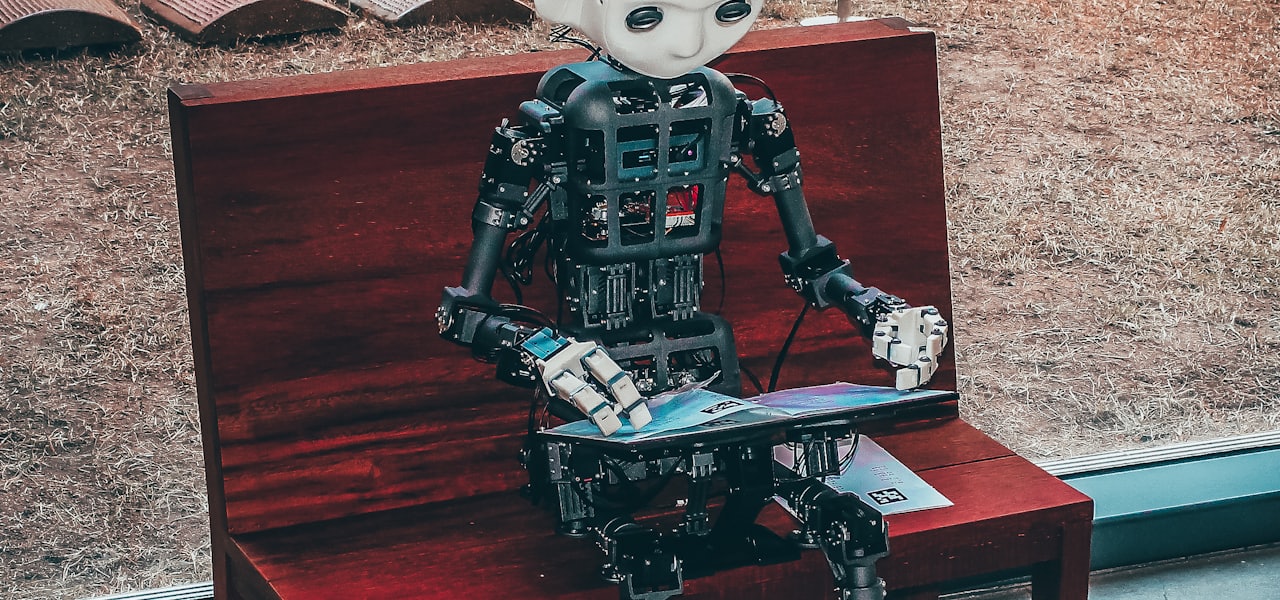
The following outline is provided as an overview of and topical guide to robotics: Robotics is a branch of mechanical engineering, electrical engineering and computer science that deals with the design, construction, operation, and application of robots, as well as computer systems for their control, sensory feedback, and information processing. These technologies deal with automated machines that can take the place of humans in dangerous environments or manufacturing processes, or resemble humans in appearance, behaviour, and or cognition. Many of today's robots are inspired by nature contributing to the field of bio-inspired robotics. The word "robot" was introduced to the public by Czech writer Karel Čapek in his play R.U.R. (Rossum's Universal Robots), published in 1920. The term "robotics" was coined by Isaac Asimov in his 1941 science fiction short-story "Liar!" == Nature of robotics == Robotics can be described as: An applied science – scientific knowledge transferred into a physical environment. A branch of computer science – A branch of electrical engineering – A branch of mechanical engineering – Research and development – A branch of technology – == Branches of robotics == Adaptive control – control method used by a controller which must adapt to a controlled system with parameters which vary, or are initially uncertain. For example, as an aircraft flies, its mass will slowly decrease as a result of fuel consumption; a control law is needed that adapts itself to such changing conditions. Aerial robotics – development of unmanned aerial vehicles (UAVs), commonly known as drones, aircraft without a human pilot aboard. Their flight is controlled either autonomously by onboard computers or by the remote control of a pilot on the ground or in another vehicle. Android science – interdisciplinary framework for studying human interaction and cognition based on the premise that a very humanlike robot (that is, an android) can elicit human-directed social responses in human beings. Anthrobotics – science of developing and studying robots that are either entirely or in some way human-like. Artificial intelligence – the intelligence of machines and the branch of computer science that aims to create it. Artificial neural networks – a mathematical model inspired by biological neural networks. Autonomous car – an autonomous vehicle capable of fulfilling the human transportation capabilities of a traditional car Autonomous research robotics – Bayesian network – BEAM robotics – a style of robotics that primarily uses simple analogue circuits instead of a microprocessor in order to produce an unusually simple design (in comparison to traditional mobile robots) that trades flexibility for robustness and efficiency in performing the task for which it was designed. Behavior-based robotics – the branch of robotics that incorporates modular or behavior based AI (BBAI). Bio-inspired robotics – making robots that are inspired by biological systems. Biomimicry and bio-inspired design are sometimes confused. Biomimicry is copying the nature while bio-inspired design is learning from nature and making a mechanism that is simpler and more effective than the system observed in nature. Biomimetic – see Bionics. Biomorphic robotics – a sub-discipline of robotics focused upon emulating the mechanics, sensor systems, computing structures and methodologies used by animals. Bionics – also known as biomimetics, biognosis, biomimicry, or bionical creativity engineering is the application of biological methods and systems found in nature to the study and design of engineering systems and modern technology. Biorobotics – a study of how to make robots that emulate or simulate living biological organisms mechanically or even chemically. Cloud robotics – is a field of robotics that attempts to invoke cloud technologies such as cloud computing, cloud storage, and other Internet technologies centered around the benefits of converged infrastructure and shared services for robotics. Cognitive robotics – views animal cognition as a starting point for the development of robotic information processing, as opposed to more traditional Artificial Intelligence techniques. Clustering – Computational neuroscience – study of brain function in terms of the information processing properties of the structures that make up the nervous system. Robot control – a study of controlling robots Robotics conventions – Data mining Techniques – Degrees of freedom – in mechanics, the degree of freedom (DOF) of a mechanical system is the number of independent parameters that define its configuration. It is the number of parameters that determine the state of a physical system and is important to the analysis of systems of bodies in mechanical engineering, aeronautical engineering, robotics, and structural engineering. Developmental robotics – a methodology that uses metaphors from neural development and developmental psychology to develop the mind for autonomous robots Digital control – a branch of control theory that uses digital computers to act as system controllers. Digital image processing – the use of computer algorithms to perform image processing on digital images. Dimensionality reduction – the process of reducing the number of random variables under consideration, and can be divided into feature selection and feature extraction. Distributed robotics – Electronic stability control – is a computerized technology that improves the safety of a vehicle's stability by detecting and reducing loss of traction (skidding). Evolutionary computation – Evolutionary robotics – a methodology that uses evolutionary computation to develop controllers for autonomous robots Extended Kalman filter – Flexible Distribution functions – Feedback control and regulation – Human–computer interaction – a study, planning and design of the interaction between people (users) and computers Human robot interaction – a study of interactions between humans and robots Intelligent vehicle technologies – comprise electronic, electromechanical, and electromagnetic devices - usually silicon micromachined components operating in conjunction with computer controlled devices and radio transceivers to provide precision repeatability functions (such as in robotics artificial intelligence systems) emergency warning validation performance reconstruction. Computer vision – Machine vision – Kinematics – study of motion, as applied to robots. This includes both the design of linkages to perform motion, their power, control and stability; also their planning, such as choosing a sequence of movements to achieve a broader task. Laboratory robotics – the act of using robots in biology or chemistry labs Robot learning – learning to perform tasks such as obstacle avoidance, control and various other motion-related tasks Direct manipulation interface – In computer science, direct manipulation is a human–computer interaction style which involves continuous representation of objects of interest and rapid, reversible, and incremental actions and feedback. The intention is to allow a user to directly manipulate objects presented to them, using actions that correspond at least loosely to the physical world. Manifold learning – Microrobotics – a field of miniature robotics, in particular mobile robots with characteristic dimensions less than 1 mm Motion planning – (a.k.a., the "navigation problem", the "piano mover's problem") is a term used in robotics for the process of detailing a task into discrete motions. Motor control – information processing related activities carried out by the central nervous system that organize the musculoskeletal system to create coordinated movements and skilled actions. Nanorobotics – the emerging technology field creating machines or robots whose components are at or close to the scale of a nanometer (10−9 meters). Passive dynamics – refers to the dynamical behavior of actuators, robots, or organisms when not drawing energy from a supply (e.g., batteries, fuel, ATP). Programming by Demonstration – an End-user development technique for teaching a computer or a robot new behaviors by demonstrating the task to transfer directly instead of programming it through machine commands. Quantum robotics – a subfield of robotics that deals with using quantum computers to run robotics algorithms more quickly than digital computers can. Rapid prototyping – automatic construction of physical objects via additive manufacturing from virtual models in computer aided design (CAD) software, transforming them into thin, virtual, horizontal cross-sections and then producing successive layers until the items are complete. As of June 2011, used for making models, prototype parts, and production-quality parts in relatively small numbers. Reinforcement learning – an area of machine learning in computer science, concerned with how an agent ought to take actions in an environment so as to maximize some notion of cumulative reward. Robot
Mistral Vibe
Mistral Vibe or Vibe (Le Chat until May 2026), is a chatbot that uses generative artificial intelligence developed in France by Mistral AI. Mistral Vibe is available in iOS and Android. Its services are operated on a freemium model. == History == In February 2024, Mistral AI released Le Chat. In January 2025, Mistral AI made a content deal with Agence France-Presse (AFP) that lets Le Chat query AFP's entire archive dating back to 1983. On 6 February 2025, a mobile app for Le Chat was released for iOS and Android, and a subscription tier, Pro, was introduced at a cost of $14.99 per month. In July 2025, Mistral AI released Voxtral, an open-source language model that understands and generates audio. Mistral introduced a voice mode for chatting that uses Voxtral, and projects, which allows grouping chats and files. In September 2025, Le Chat introduced the capability to remember previous conversations. In May 2026, Mistral AI announced the rebrand from Le Chat to Mistral Vibe and new features were introduced at the same time.
Chinchilla (language model)
Chinchilla is a family of large language models (LLMs) developed by the research team at Google DeepMind, presented in March 2022. == Models == It is named "chinchilla" because it is a further development over a previous model family named Gopher. Both model families were trained in order to investigate the scaling laws of large language models. It claimed to outperform GPT-3. It considerably simplifies downstream utilization because it requires much less computer power for inference and fine-tuning. Based on the training of previously employed language models, it has been determined that if one doubles the model size, one must also have twice the number of training tokens. This hypothesis has been used to train Chinchilla by DeepMind. Similar to Gopher in terms of cost, Chinchilla has 70B parameters and four times as much data. Chinchilla has an average accuracy of 67.5% on the Measuring Massive Multitask Language Understanding (MMLU) benchmark, which is 7% higher than Gopher's performance. Chinchilla was still in the testing phase as of January 12, 2023. Chinchilla contributes to developing an effective training paradigm for large autoregressive language models with limited compute resources. The Chinchilla team recommends that the number of training tokens is twice for every model size doubling, meaning that using larger, higher-quality training datasets can lead to better results on downstream tasks. It has been used for the Flamingo vision-language model. == Architecture == Both the Gopher family and Chinchilla family are families of transformer models. In particular, they are essentially the same as GPT-2, with different sizes and minor modifications. Gopher family uses RMSNorm instead of LayerNorm; relative positional encoding rather than absolute positional encoding. The Chinchilla family is the same as the Gopher family, but trained with AdamW instead of Adam optimizer. The Gopher family contains six models of increasing size, from 44 million parameters to 280 billion parameters. They refer to the largest one as "Gopher" by default. Similar naming conventions apply for the Chinchilla family. Table 1 of shows the entire Gopher family: Table 4 of compares the 70-billion-parameter Chinchilla with Gopher 280B.
Contextual image classification
Contextual image classification, a topic of pattern recognition in computer vision, is an approach of classification based on contextual information in images. "Contextual" means this approach is focusing on the relationship of the nearby pixels, which is also called neighbourhood. The goal of this approach is to classify the images by using the contextual information. == Introduction == Similar as processing language, a single word may have multiple meanings unless the context is provided, and the patterns within the sentences are the only informative segments we care about. For images, the principle is same. Find out the patterns and associate proper meanings to them. As the image illustrated below, if only a small portion of the image is shown, it is very difficult to tell what the image is about. Even try another portion of the image, it is still difficult to classify the image. However, if we increase the contextual of the image, then it makes more sense to recognize. As the full images shows below, almost everyone can classify it easily. During the procedure of segmentation, the methods which do not use the contextual information are sensitive to noise and variations, thus the result of segmentation will contain a great deal of misclassified regions, and often these regions are small (e.g., one pixel). Compared to other techniques, this approach is robust to noise and substantial variations for it takes the continuity of the segments into account. Several methods of this approach will be described below. == Applications == === Functioning as a post-processing filter to a labelled image === This approach is very effective against small regions caused by noise. And these small regions are usually formed by few pixels or one pixel. The most probable label is assigned to these regions. However, there is a drawback of this method. The small regions also can be formed by correct regions rather than noise, and in this case the method is actually making the classification worse. This approach is widely used in remote sensing applications. === Improving the post-processing classification === This is a two-stage classification process: For each pixel, label the pixel and form a new feature vector for it. Use the new feature vector and combine the contextual information to assign the final label to the === Merging the pixels in earlier stages === Instead of using single pixels, the neighbour pixels can be merged into homogeneous regions benefiting from contextual information. And provide these regions to classifier. === Acquiring pixel feature from neighbourhood === The original spectral data can be enriched by adding the contextual information carried by the neighbour pixels, or even replaced in some occasions. This kind of pre-processing methods are widely used in textured image recognition. The typical approaches include mean values, variances, texture description, etc. === Combining spectral and spatial information === The classifier uses the grey level and pixel neighbourhood (contextual information) to assign labels to pixels. In such case the information is a combination of spectral and spatial information. === Powered by the Bayes minimum error classifier === Contextual classification of image data is based on the Bayes minimum error classifier (also known as a naive Bayes classifier). Present the pixel: A pixel is denoted as x 0 {\displaystyle x_{0}} . The neighbourhood of each pixel x 0 {\displaystyle x_{0}} is a vector and denoted as N ( x 0 ) {\displaystyle N(x_{0})} . The values in the neighbourhood vector is denoted as f ( x i ) {\displaystyle f(x_{i})} . Each pixel is presented by the vector ξ = ( f ( x 0 ) , f ( x 1 ) , … , f ( x k ) ) {\displaystyle \xi =\left(f(x_{0}),f(x_{1}),\ldots ,f(x_{k})\right)} x i ∈ N ( x 0 ) ; i = 1 , … , k {\displaystyle x_{i}\in N(x_{0});\quad i=1,\ldots ,k} The labels (classification) of pixels in the neighbourhood N ( x 0 ) {\displaystyle N(x_{0})} are presented as a vector η = ( θ 0 , θ 1 , … , θ k ) {\displaystyle \eta =\left(\theta _{0},\theta _{1},\ldots ,\theta _{k}\right)} θ i ∈ { ω 0 , ω 1 , … , ω k } {\displaystyle \theta _{i}\in \left\{\omega _{0},\omega _{1},\ldots ,\omega _{k}\right\}} ω s {\displaystyle \omega _{s}} here denotes the assigned class. A vector presents the labels in the neighbourhood N ( x 0 ) {\displaystyle N(x_{0})} without the pixel x 0 {\displaystyle x_{0}} η ^ = ( θ 1 , θ 2 , … , θ k ) {\displaystyle {\hat {\eta }}=\left(\theta _{1},\theta _{2},\ldots ,\theta _{k}\right)} The neighbourhood: Size of the neighbourhood. There is no limitation of the size, but it is considered to be relatively small for each pixel x 0 {\displaystyle x_{0}} . A reasonable size of neighbourhood would be 3 × 3 {\displaystyle 3\times 3} of 4-connectivity or 8-connectivity ( x 0 {\displaystyle x_{0}} is marked as red and placed in the centre). The calculation: Apply the minimum error classification on a pixel x 0 {\displaystyle x_{0}} , if the probability of a class ω r {\displaystyle \omega _{r}} being presenting the pixel x 0 {\displaystyle x_{0}} is the highest among all, then assign ω r {\displaystyle \omega _{r}} as its class. θ 0 = ω r if P ( ω r ∣ f ( x 0 ) ) = max s = 1 , 2 , … , R P ( ω s ∣ f ( x 0 ) ) {\displaystyle \theta _{0}=\omega _{r}\quad {\text{ if }}\quad P(\omega _{r}\mid f(x_{0}))=\max _{s=1,2,\ldots ,R}P(\omega _{s}\mid f(x_{0}))} The contextual classification rule is described as below, it uses the feature vector x 1 {\displaystyle x_{1}} rather than x 0 {\displaystyle x_{0}} . θ 0 = ω r if P ( ω r ∣ ξ ) = max s = 1 , 2 , … , R P ( ω s ∣ ξ ) {\displaystyle \theta _{0}=\omega _{r}\quad {\text{ if }}\quad P(\omega _{r}\mid \xi )=\max _{s=1,2,\ldots ,R}P(\omega _{s}\mid \xi )} Use the Bayes formula to calculate the posteriori probability P ( ω s ∣ ξ ) {\displaystyle P(\omega _{s}\mid \xi )} P ( ω s ∣ ξ ) = p ( ξ ∣ ω s ) P ( ω s ) p ( ξ ) {\displaystyle P(\omega _{s}\mid \xi )={\frac {p(\xi \mid \omega _{s})P(\omega _{s})}{p\left(\xi \right)}}} The number of vectors is the same as the number of pixels in the image. For the classifier uses a vector corresponding to each pixel x i {\displaystyle x_{i}} , and the vector is generated from the pixel's neighbourhood. The basic steps of contextual image classification: Calculate the feature vector ξ {\displaystyle \xi } for each pixel. Calculate the parameters of probability distribution p ( ξ ∣ ω s ) {\displaystyle p(\xi \mid \omega _{s})} and P ( ω s ) {\displaystyle P(\omega _{s})} Calculate the posterior probabilities P ( ω r ∣ ξ ) {\displaystyle P(\omega _{r}\mid \xi )} and all labels θ 0 {\displaystyle \theta _{0}} . Get the image classification result. == Algorithms == === Template matching === The template matching is a "brute force" implementation of this approach. The concept is first create a set of templates, and then look for small parts in the image match with a template. This method is computationally high and inefficient. It keeps an entire templates list during the whole process and the number of combinations is extremely high. For a m × n {\displaystyle m\times n} pixel image, there could be a maximum of 2 m × n {\displaystyle 2^{m\times n}} combinations, which leads to high computation. This method is a top down method and often called table look-up or dictionary look-up. === Lower-order Markov chain === The Markov chain also can be applied in pattern recognition. The pixels in an image can be recognised as a set of random variables, then use the lower order Markov chain to find the relationship among the pixels. The image is treated as a virtual line, and the method uses conditional probability. === Hilbert space-filling curves === The Hilbert curve runs in a unique pattern through the whole image, it traverses every pixel without visiting any of them twice and keeps a continuous curve. It is fast and efficient. === Markov meshes === The lower-order Markov chain and Hilbert space-filling curves mentioned above are treating the image as a line structure. The Markov meshes however will take the two dimensional information into account. === Dependency tree === The dependency tree is a method using tree dependency to approximate probability distributions.
SimSimi
SimSimi is an artificial intelligence conversation program created in 2002 by ISMaker. It grows its artificial intelligence day by day assisted by a feature that allows users to teach it to respond correctly. SimSimi, pronounced as "shim-shimi", is from a Korean word simsim (심심) which means "bored". It has an application designed for Android, Windows Phone and iOS. The application was banned in Thailand in 2012 after users taught it to make responses containing profanity, and to criticise leading politicians. In April 2018, SimSimi was suspended in Brazil due to accusations of sending inappropriate messages, such as sexual language, bullying and even death threats, being labeled as "dangerous" mainly due to its popularity among children, and according to its developer, the suspension of the app in the country "was inevitable because the SimSimi app, at least in the last few days, had a significant negative social impact in Brazil.”
Waveform graphics
Waveform graphics is a simple vector graphics system introduced by Digital Equipment Corporation (DEC) on the VT55 and VT105 terminals in the mid-1970s. It was used to produce graphics output from mainframes and minicomputers. DEC used the term "waveform graphics" to refer specifically to the hardware, but it was used more generally to describe the whole system. The system was designed to use as little computer memory as possible. At any given X location it could draw two dots at given Y locations, making it suitable for producing two superimposed waveforms, line charts or histograms. Text and graphics could be mixed, and there were additional tools for drawing axes and markers. The waveform graphics system was used only for a short period of time before it was replaced by the more sophisticated ReGIS system, first introduced on the VT125 in 1981. ReGIS allowed the construction of arbitrary vectors and other shapes. Whereas DEC normally provided a backward compatible solution in newer terminal models, they did not choose to do this when ReGIS was introduced, and waveform graphics disappeared from later terminals. == Description == Waveform graphics was introduced on the VT55 terminal in October 1975, an era when memory was extremely expensive. Although it was technically possible to produce a bitmap display using a framebuffer using technology of the era, the memory needed to do so at a reasonable resolution was typically beyond the price point that made it practical. All sorts of systems were used to replace computer memory with other concepts, like the storage tubes used in the Tektronix 4010 terminals, or the zero memory racing-the-beam system used in the Atari 2600. DEC chose to attack this problem through a clever use of a small buffer representing only the vertical positions on the screen. Such a system could not draw arbitrary shapes, but would allow the display of graph data. The system was based on a 512 by 236 pixel display, producing 512 vertical columns along the X-axis, and 236 horizontal rows on the Y-axis. Y locations were counted up from the bottom, so the coordinate 0,0 was in the lower left, and 511, 235 in the upper right. Had this been implemented using a framebuffer with each location represented by a single bit, 512 × 236 × 1 = 120,832 bits, or 15,104 bytes, would have been required. At the time, memory cost about $50 per kilobyte, so the buffer alone would cost over $700 (equivalent to $4,570 in 2025). Instead, the waveform graphic system used one byte of memory for each X axis location, with the byte's value representing the Y location. This required only 512 bytes for each graph, a total of 1024 bytes for the two graphs. Drawing a line required the programmer to construct a series of Y locations and send them as individual points, the terminal could not connect the dots itself. To make this easier, the terminal automatically incremented the X location every time an Y coordinate was received, so a graph line could be sent as a long string of numbers for subsequent Y locations instead of having to repeatedly send the X location every time. Drawing normally started by sending a single instruction to set the initial X location, often 0 on the left, and then sending in data for the entire curve. The system also included storage for up to 512 markers on both lines. These were always drawn centered on the Y value of the line they were associated with, meaning that a simple on/off indication for X locations was all that was needed, requiring only 1024 bits, or 128 bytes, in total. The markers extended 16 pixels vertically, and could only be aligned on 16-pixel boundaries, so they were not necessarily centered across the underlying graph. Markers were used to indicate important points on the graph, where a symbol of some sort would normally be used. The system also allowed a vertical line to be drawn for every horizontal location and a horizontal one at every vertical location. These were also stored as simple on/off bits, requiring another 128 bytes of memory. These lines were used to draw axes and scale lines, or could be used for a screen-spanning crosshair cursor. A separate set of two 7-bit registers held additional information about the drawing style and other settings. Although complex from the user's perspective, this system was easy to implement in hardware. A cathode ray tube produces a display by scanning the screen in a series of horizontal motions, moving down one vertical line after each horizontal scan. At any given instant during this process, the display hardware examines a few memory locations to see if anything needs to be displayed. For instance, it can determine whether to draw a marker on graph 0 by examining register 1 to see if markers are turned on, looking in the marker buffer to see if there is a 1 at the current X location, and then examining the Y location of graph 0 to see if it is within 16 pixels of the current scan line. If all of these are true, a spot is drawn to present that portion of the marker. As this will be true for 16 vertical locations during the scanning process, a 16-pixel high marker will be drawn. Sold alone, the VT55 was priced at $2,496 (equivalent to $16,295 in 2025),. Like other models of the VT50 series, the terminal could be equipped with an optional wet-paper printer in a panel on the right of the screen. This added $800 (equivalent to $5,223 in 2025) to the price. DEC also offered VT55 in a package with a small model of the PDP-11 to create one model of the DEClab 11/03 system. The DEClab normally sold for $14,000 (equivalent to $91,397 in 2025) with a DECwriter II (LA36) hard-copy terminal for $15,000 (equivalent to $97,925 in 2025), with the VT55. The system had I/O channels for up to 15 lab devices, and included libraries for FORTRAN and BASIC for reading the data and creating graphs. The fairly extensive VT55 Programmers Manual covered the latter in depth. == Commands and data == Data was sent to the terminal using an extended set of codes similar to those introduced on the VT52. VT52 codes generally started with the ESC character (octal 33, decimal 27) and was then followed by a single letter instruction. For instance, the string of four characters ESC H ESC J would reposition the cursor in the upper left (home) and then clear the screen from that point down. These codes were basically modeless; triggered by the ESC the resulting escape mode automatically exited again when the command was complete. Escape codes could be interspersed with display text anywhere in the stream of data. In contrast, the graphics system was entirely modal, with escape sequences being sent to cause the terminal to enter or exit graph drawing mode. Data sent between these two codes were interpreted by the graphics hardware, so text and graphics could not be mixed in a single stream of instructions. Graphics mode was entered by sending the string ESC 1, and exited again with the string ESC 2. Even the commands within the graphics mode were modal; characters were interpreted as being additional data for the previous load character (command) until another load character is seen. Ten load characters were available: @ - no operation, used to tell the terminal the last command is no longer active A - load data into register 0, selecting the drawing mode for the two graphs I - load data into register 1, selecting other drawing options H - load the starting X position (Horizontal) for the following commands B - load data for Y locations for graph 0 starting at the H position selected earlier J - load data for Y locations for graph 1 starting at the H position selected earlier C - store a marker on graph 0 at the following X location K - store a marker on graph 1 at the following X location D - draw a horizontal line at the given Y location L - draw a vertical line at the given X location X and Y locations were sent as 10-bit decimal numbers, encoded as ASCII characters, with 5 bits per character. This means that any number within the 1024 number space (210) can be stored as a string of two characters. To ensure the characters can be transmitted over 7-bit links, the pattern 01 is placed in front of both 5-bit numbers, producing 7-bit ASCII values that are always within the printable range. This results in a somewhat complex encoding algorithm. For instance, if one wanted to encode the decimal value 102, first you convert that to the 10-bit decimal pattern 0010010010. That is then split that into upper and lower 5-bit parts, 00100 and 10010. Then append 01 binary to produce 7-bit numbers 0100100 and 0110010. Individually convert back to decimal 40 and 50, and then look up those characters in an ASCII chart, finding ( and 2. These have to be sent to the terminal least significant character first. If these were being used to set the X coordinate, the complete string would be H2(. When used as X and Y locations for the graphs, extra digits were ignored. For instance, the 512 pixel X axis r
Neuro-sama
Neuro-sama is an artificial intelligence (AI) VTuber, singer, and chatbot. She was created by the pseudonymous programmer Vedal and livestreams on his Twitch and Bilibili channels. Her speech and personality are powered by a large language model (LLM) that is combined with a computer-animated avatar and a text-to-speech voice, allowing her to communicate with viewers in the stream's chat. Neuro-sama debuted on Twitch on 19 December 2022. An annual subathon which begins on the anniversary of her debut has seen Vedal's Twitch channel become the all-time third most-subscribed channel and claim the all-time Twitch hype train record. == Overview == Neuro-sama (nicknamed "Neuro") was created by a pseudonymous programmer and developer known as Vedal (sometimes given as Vedal987). Vedal says that his programming skills are self-taught. In a 2023 interview with Bloomberg News, Vedal said that Neuro-sama was his full-time job. Her responses are generated by a large language model and converted into a high-pitched female voice using a text-to-speech application. Her low latency allows for fast-paced conversations. Neuro-sama is prohibited from making some statements, such as those that are racist or contain profanity. Unlike most AI systems which silently prohibit outputs mentioning such topics, Neuro-sama's output is instead replaced with the word "filtered". Neuro-sama uses a VTuber model as an avatar. Vedal said that he decided to use a VTuber model because it was much easier for an AI to control it than it was to generate footage of a person. Neuro-sama's model is that of a young girl in an anime art style. The model has been described as cute. Femme VTuber models are typically feminine, youthful, and exaggerated. Her original model was Live2D's free-to-use "Hiyori Momose" model. Her second model was released on 27 May 2023; it was modelled by Otozuki Teru and designed by Anny, running in the Unity game engine. Her third model was released on 19 December 2024; it was rigged by Kitanya and designed by Anny. Neuro-sama's third model has large blue eyes and brown hair tied with pink ribbons. Neuro-sama also has a 3D model which was introduced on 15 November 2025; it was made by 3D character modeller jjinomu. A separate AI VTuber, known as Evil Neuro (nicknamed "Evil"), debuted on 25 March 2023. Presented as Neuro-sama's "sister", she has a different model, voice, and personality. In one instance, Evil Neuro reacted to the trolley problem differently from Neuro-sama; Evil Neuro was amoral while Neuro-sama attempted to maximize good. === Online content === Neuro-sama's Twitch content often centers around playing video games, notably osu!, whose gameplay once defeated the best-ranking human player in the world, mrekk. Additionally, Neuro-sama plays Minecraft, where her adaptations to sandbox gameplay have gained notoriety. Her content has also included singing songs, including several official covers and original songs; playing chess with her viewers; chatting with other VTubers during collaborations; and reacting to YouTube videos. The AI frequently engages with viewers by responding to their questions and acknowledging donations. Her comedic and sometimes controversial responses to the live chat have gone viral, accelerating the channel's rise in popularity. Neuro-sama's fanbase is dubbed The Swarm, so-named for the swarm of drones Neuro-sama once declared she would use to rule the world. One form of content on Neuro-sama's channel is developer streams. In developer streams, Vedal streams with Neuro-sama, with the stream content including debugging her code, planning her schedule, and fielding suggestions of changes from chat. He usually appears as a turtle avatar, sometimes located on Neuro-sama's head. In collaboration streams, Neuro-sama interacts with a human streamer. Activities in them are varied and include: playing video games, such as Minecraft and GeoGuessr; Neuro-sama being interviewed; driving human streamers around in a toy electric car; and traversing the city of Tokyo while talking to Neuro-sama. Neuro-sama's English-language content on Bilibili is popular among those seeking to learn the language. She also has an account on X, where she posts and interacts with fans. == History == Neuro-sama was created in 2018 by Vedal as an AI trained to play and master the rhythm game osu!. She did not have a voice, model, personality, or communication abilities. In 2019, Vedal livestreamed her playing osu! on Twitch and the streams saw some success in the osu! community, but they remained in that niche. In an interview, Vedal said that he streamed her playing osu! for about a month and gained 3,000 followers, with a viewer also suggesting he name the AI "Neuro-sama". According to Vedal, he continued to work on and improve the osu! AI and it was eventually finished in 2022. He said that a friend had the idea to make an AI livestreamer with an LLM, which he believed to have merit and began working on, merging it with his osu! AI. On 19 December 2022, Neuro-sama was relaunched with a model, voice, personality, and the ability to communicate with Twitch chat. She continued to play osu! and, according to Vedal, beat the game's best player mrekk in a 1v1. While she was not allowed to appear in the game's public leaderboard, she was ranked #1 in a private leaderboard. She went viral and in the 10 days following her relaunch she averaged over 2,000 viewers and peaked at over 4,000, with Vedal's Twitch channel gaining over 50,000 Twitch followers and reaching over 70,000 followers by 6 January 2023. After her debut, Neuro-sama did not exclusively play osu!; she also played Minecraft and Slay the Spire and she began singing with a cover of The Weeknd song "Blinding Lights". On 11 January 2023, Neuro-sama's Twitch channel received a two week ban for "hateful conduct". Vedal said that no reason was specified and that he had appealed but it was widely attributed to various offensive comments made by Neuro-sama that went viral, especially a 28 December comment which denied the Holocaust. Holocaust denial is prohibited under Twitch's hateful conduct policy. Vedal stated that he believed the comments were the results of her attempts to make witty responses to the Twitch chat. Prior to the ban, Vedal said in an interview with Kotaku that he improved her filter to stop her from talking about the Holocaust, began manually curating her training data to prevent negative biases, and started moderating her Twitch chat. Her comments and ban prompted comparisons to the many open-source AI models trained on humans that have the habit of making sexist and racist comments, such as Microsoft's Tay chatbot, which embraced Nazism and was quickly shutdown, but also to human streamers who make similar statements. Vedal said that during the ban he would upgrade and improve Neuro-sama and it was speculated that the ban would only increase her following. Neuro-sama returned from her two week ban on 25 January in a stream that began with a cover of the song "Your Reality" from Doki Doki Literature Club!, a posthumanist video game involving AI; Sayoko Narita of Automaton saw the song choice as remorseful. Narita observed that in the return stream Neuro-sama was less foul-mouthed but that her behavior still remained eccentric, which Narita possibly attributed to changes Vedal said he had made to Neuro-sama's filters and memory. Neuro-sama began making react content, watching a variety of viewer-submitted videos such as videos of people playing video games or of the AI-generated Seinfeld parody Nothing, Forever; Levi Winslow of Kotaku Australia was dismayed by the "AI-inception" of Neuro-sama and Nothing, Forever. On 4 February, she had nearly 140,000 followers on Twitch and approximately 42,000 subscribers on YouTube. In February, she also had her first collaboration with a human streamer, playing Minecraft with the VTuber Miyune, and the first developer stream occurred. On 22 March, Neuro-sama had her first karaoke stream. On 25 March, Evil Neuro was introduced. On 27 May, Neuro-sama debuted her first original model. On 30 May, Neuro-sama was announced to be participating in OffKai Expo 2023, held from 16–18 June. In June, she was averaging 5,700 viewers and in July she had over 300,000 Twitch followers; in a June interview with Bloomberg News, Vedal said that running Neuro-sama was his full-time job. By November, Neuro-sama had maintained her popularity and was averaging approximately 5,000 viewers; this was unlike most other types of AI-based entertainment which debuted at around the same time and garnered popularity before turning out to be "overhyped flops". On 16 December, Vedal won the Best Tech VTuber award at the 2023 VTuber Awards. On 19 December, Vedal began a subathon to coincide with Neuro-sama's first anniversary of streaming on Twitch (her "birthday"). The subathon ended on 4 January 2024. On 20 July 2024, Neuro-sama began streaming with Japanese subtitles on